 |
| University College London |
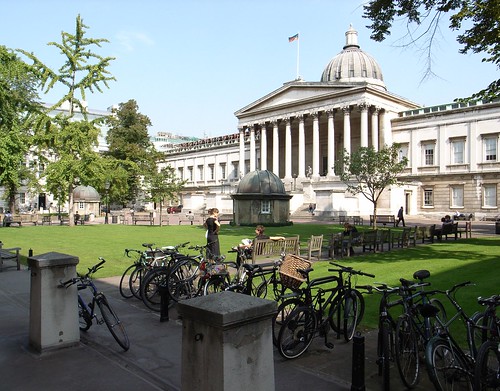
After months of anticipation, the first day of class finally arrived. Arriving at the UCL campus, we were greeted by our UCL Department of Information Studies faculty instructors, Anthony Watkinson and Andy Dawson and Pratt SILS Dean Tula Giannini.
 |
| Anthony Watkinson |
Following introductions, the goals of the course were laid-out. The main focus would be on the impact of e-books, both in libraries and in the publishing world (mainly in the academic sphere). Anthony, who is a former publisher, academic librarian, and a member of UCL'sCentre for Publishing said he saw the class as a way to "bring publishers and librarians together," as their roles are becoming increasingly symbiotic in the digital age.
We were then issued UCL ID's and led on a tour of the campus (including a meeting withJeremy Bentham himself!).
CIBER and Online Behavior
Following the orientation, the class' first lecture was given by Dr. Ian Rowlands, Reader in the UCL Department of Information Studies and Director of Research for CIBER - a "policy-led, consumer-driven, interdisciplinary and independent research group" based at UCL.
According to Dr. Rowlands, understanding online behavior is one of CIBER's main research goals.He said that "human memory is not as concise as browsing history, so the group has been conducting studies using Deep Log Analysis (DLA), which uses IP addresses to track date and time stamp; operating sysytem; browser; time spent; downloads; and what was printed. Usind DLA, the online behaviors of users can be studied. The strengths of DLA include the production of comprehensive data with no sampling issues. The data is free from people's flawed "memories" and psychological hang-ups about recording what they do online. The research reveals what people actually did, not what they remember doing. DLA also offers grounded theory, with no assumptions or set theory. The research simply reveals what it reveals.
Dr. Rowlands did admit that DLA has some drawbacks. These weaknesses include the fact that there is little to no context for the background on why the online behavior is being conducted. The unit of analysis is the session of time spent online, not the individual. It can be difficult to determine what behavior patterns mean and value judgments are inappropriate. Some proto-theories have emerged, however, such as the idea of "power browsing," the reading of abstracts; tables of contents; titles; etc...to distill content, without doing full text reading.
The research has also revealed other interesting facts: People spend more time in e-book shops than actually reading e-books. Scholars display similar online behavior as regular people. For example, they will generally initially restrict their searching to 1-2 keywords. Scholars also seem to lean towards a more web 2.0 type of environment, and want library/publishing sites to be more engaging, with more of a community discussion, such as recommendations for resources
Dr. Rowlands recommended the following as further reading, reviews of which may be found in the literature review section of this blog:
Science, "Strategic Reading, Ontologies, and the Future of Scientific Publishing," by Allen H. Renear and Carole L. Palmer
Our first day was closed out with an evening reception hosted by the Department of Information Studies and the Centre for Publishing. It was a great way to get to know my fellow classmates, the faculty, and even some UCL students.

No comments:
Post a Comment